
From THE GLOBAL VILLAGE, Marshall McLuhan, Bruce R. Powers
Accidental poetry: “reverses into a cosmic environment,” “obsolesces stars”
One Commenta writer's notebook
jotter
From THE GLOBAL VILLAGE, Marshall McLuhan, Bruce R. Powers
Accidental poetry: “reverses into a cosmic environment,” “obsolesces stars”
One Comment“The majority of the signals do not travel from the eyes to the brain: they go the other way, from the brain to the eyes. What happens is that the brain expects to see something, on the basis of what it knows and has previously occurred. The brain elaborates an image of what it predicts the eyes should see. This information is conveyed from the brain to the eyes, through intermediate stages. If a discrepancy is revealed between what the brain expects and the light arriving into the eyes, only then do the neural circuits send signals towards the brain. So images from around us do not travel from the eyes to the brain – only news of discrepancies regarding what the brain expects do.”
– Carlo Rovelli
Sometimes this country feels like it has a lid on it. Sometimes it’s no wonder that we are among the cruelest people on Earth. The callousness of cold people who only see the light for a few weeks of the year should never be underestimated. They used to say that the sun will never set on the British Empire because God doesn’t trust the bastards in the dark. They never understood that we live in the dark and we were to be most distrusted when we came out into the sunlight. And decided to steal it.
Comments closedComics covers have three jobs to do.
There have been many arguments over the years about what a cover should be, but these are my rules.
I always prefer the cover to be done by the interior artist, but, if, for whatever reason, that’s not possible, then the cover should embody the tone of the book and its general themes. It does not have to be about precisely whatever is happening in the book itself. It represents the feel and atmosphere of the work.
My pitch for the PLANETARY covers was, every issue, the book would look nothing like anything else on the stands. Think about how comics are displayed in comics stores etc, sure, but think first about the impact of the image and design and what it does to you as a viewer and participant. The cover has to make you want to pick the book up and find out about it.
The third rule is the hardest, as everyone has different tastes. But when you have it, ask yourself: is this a thing I would want in my own home? On a table, or on a wall? Is it a beautiful object that would make my home a slightly lovelier place if I owned it? If your answer is, “well, it just does the job it’s supposed to do,” then it’s the wrong cover.
Now, here’s a completely counter intuitive example:
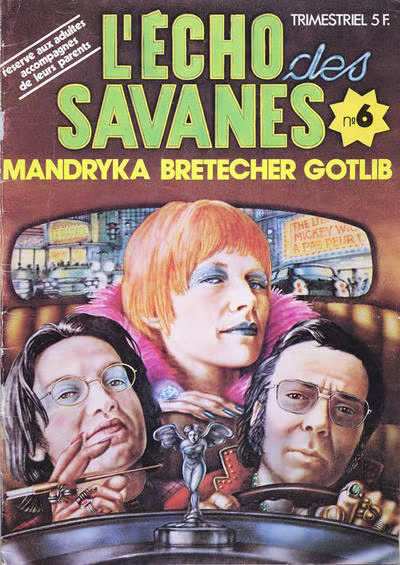
L’ECHO DES SAVANES was a French comics anthology magazine. This issue is from 1974. Those are the three editors and founders on the cover, the cartoonists Nikita Mandryka, Claire Bretecher and Marcel Gotlib. First, let us admire the flex: the editors had themselves painted for the cover of their own comic.
The tone of the thing? These three want to take you on a midnight ride through the dirty city. Gotlib looks a bit sleazy, Mandryka is a sinister intellectual and can we all just agree that Claire Bretecher looks incredibly fucking cool? You know what’s being promised.
Even in an age of fantastical comics covers in France, I bet you no other editorial team were getting themselves painted for a cover as creatures of the night who were ready to take you places you may not be ready to be taken to.
As an object, it is of its time, and there’s a little bit of big-head caricature to it. But it’s a lovely bit of painting, and the whole thing just makes me smile. It bypasses all the rules we have for comics covers and rides off into the dark.
Next time you’re near a comics or book store, have a look at the shelves, see what jumps out at you, and ask yourself why. It’s a useful question. And you’ll learn more about your own tastes as well as what design does to you.
(Previously published on my newsletter 5 January 2025. Click here to subscribe for free.)
Comments closedComments closedIn a short and opaque text entitled “On the Black Universe,” the French thinker François Laruelle extends this idea of black as a cosmological principle. Neither an aesthetics of color nor a metaphor for knowledge and ignorance, black is, for Laruelle, inseparable from the conditions of thought and its limit. Separate from “the World” we make in our own, all-too-human image, and apart from “the Earth” which tolerates our habitation of its surface, there is “the Universe” – indifferent, opaque, black: “Black prior to light is the substance of the Universe, what escaped from the World before…
The human race has had the technical ability to send a crewed mission to Mars for decades.
All the human race is currently missing is the proven technical ability to get a crewed mission there safely, in a decent period of time, without the crew dying, landing without the crew dying, keeping everyone alive on the surface, launching back to orbit safely, and getting everyone back to earth again without the crew dying.
If you want to just stick a bunch of engines and fuel tanks to a shipping container and fire it in the general direction of Mars on a straight injection, then von Braun of the SS wrote that technical specification in 1948.
Comments closed
The death of David Lynch was announced yesterday.
I have a lot to think about today.
“Even after the image of the running man is cut on screen, the viewer still imagines the runner completing his task. Deleuze references Aristotle and the notion of the first mover to explain how our mind continues a movement even after the image has gone. “Light is stronger than the story,” he wrote.”
– Paul Schrader
My daughter was born at night. The new maternity ward was several floors up in the hospital, because you really want pregnant women to have to climb stairs, and very little worked properly. But the midwives and staff were wondrous.
My daughter was born, and the midwife muttered, “they’re not supposed to be able to do that,” and my new-born daughter was trying to raise her head and look around to see where she’d landed.
Not long after, it was my turn to hold her for the first time. I took her to the window. From up there, we could see all the lights of the town at night. And I held her up to the light-splashed window, and introduced her to the world, and asked it to be kind to her.
Comments closedMathieu Amalric in COSMOPOLIS:
“They put me in black hole until I was screaming for my eyes.”
Comments closed