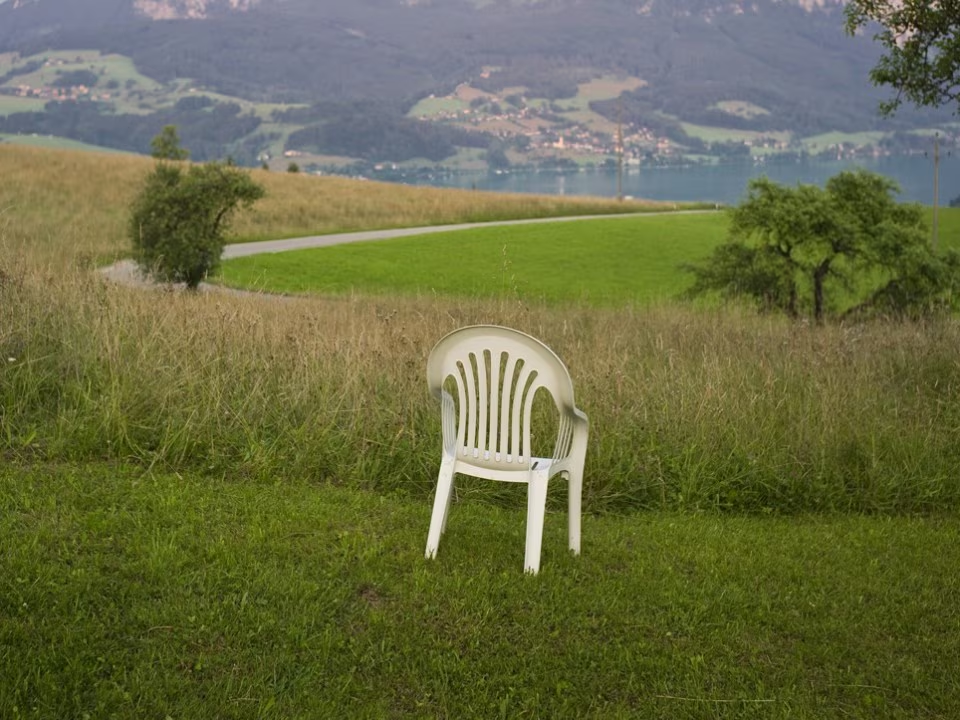
Moving some stuff in the office, discovered this: my family buys me the oddest shit for Xmas and I love them for it,

Moving some stuff in the office, discovered this: my family buys me the oddest shit for Xmas and I love them for it,
Watching a pigeon eating berries off the holly tree.
I have entirely too much to do today, enough that I can’t get it all in order in my head. Worse, I have an itch to mask up and wade into the junk room and start sorting it all out. Which is usually a sign of my back-brain telling me that I need to walk away from screens and keyboards.
It’s weird to wake up to a cat wanting love and attention. Our other cats have always all attached themselves to herself and the child. I’ve never had one who just wants to come to me. (Who also wants to try and eat my legs as I attempt to stagger downstairs.)

Han Kang won the Nobel for Literature this year (once again, my guy Krasznahorkai shut out), and I hadn’t read anything by her, so off to Amazon I went. Turns out I chose one of her slimmest books. Slim like a knife. Right in the gut.
The Nobel announcement strongly indicated she was a “trauma” writer in the general autofiction zone. There is a piece early on in this book that… if your chest doesn’t clench and your eyes don’t well, you’re probably dead. It was horrible, heartbreaking and perfectly weighted to destroy the reader.
What do the ghosts of this city do, these muffled early-morning hours? Slip soundlessly out to walk through the fog that has been holding its breath, and waiting? Do they greet each other, through the gaps between those water molecules which bleach their voices white? In some mother tongue of their own, another whose meaning eludes me? Or do they only shake or nod their heads, without the need for words?
Han started out to write a book about things that are white, apparently. This seemed quickly to lead her to death and horror – I have started to wonder if trauma-narrative isn’t just high literary horror – and to what I’ve seen termed “inherited pain.” Han had an older sister who only lived a couple of hours. Sequences of this book are Han imagining the world seen through her dead sister’s eyes.
her mind turned to thoughts of nebulae. To the thousands of stars like grains of salt whose light had streamed down to her, those nights at her parents’ countryside home. Clean, cold light that had bathed her eyes, scouring her mind of all memory.
It goes in hard and cold. In its own words, “cold and irrevocable.” There is nothing warm or soft in it. Everything in it has a frost-rimed edge.
A lot of it is set during a period Han spent living in Poland as a writing retreat, and I get the sense a European Fimbulwinter didn’t do her much good. It is, however, beautifully written, in a translation by Deborah Smith. (And suddenly I realise how much translated work I read these days.)
Only once does it let hopeful light in.
It is not true that everything is coloured by time and suffering. It is not true that they bring everything to ruin.
It is extraordinarily well done, but it is like living inside a grieving person’s nightmares. And that person is grieving for everything.

An entertaining whistlestop tour of a few hundred years of Roman history.
As a coda to the destruction of Macedon, a Roman embassy was sent to Alexandria where the new Seleucid king, Antiochus IV, was taking advantage of the political chaos that had enveloped the kingdom, in order to try to conquer Egypt. They met at Eleusis, not far from Alexandria. As Antiochus approached, the chief Roman ambassador, Gaius Popillius Laenas (himself a former consul and brother of the man who had been so abominable to the Ligurians), is said to have drawn a circle around him with his cane, telling Antiochus that before he stepped out of it he would have to decide whether or not to leave Egypt and accept peace with Rome.
This is the same Eleusis that was home to the Eleusinian Mysteries, which have long fascinated me.
Cassius’ early history include the view that Faunus – often considered a native Italian divinity with prophetic powers – was actually a man whom Evander, the oldest Greek settler in Latium, had met when he arrived there and called a god. Similarly, Hercules was really a robust farmer of Greek extraction, who had likewise lived in Latium but before the arrival of Evander; while the Greeks who allowed Aeneas to pass freely through their ranks because they so respected him created the concept of sacrosanctity – the inviolability of a person.
There’s probably a story there. Sacrosanctity was extended from there to Roman tribunes, the administrators elected by the people for the people.
Rome’s last king, Tarquinius Superbus, invent(ed) crucifixion.
I’ve got a hundred Kindle notes from this book. The benefit of the whistlestop tour is that Potter can strew the book with many many wonderful little facts.
Vespasian arrived in Rome in the autumn of AD 70 and would not leave Italy again. Concentrating his energies on restoring the state finances, ruined by Nero and the subsequent wars, he would also oversee some massive construction projects in Rome and the restructuring of the imperial defences. He would be long remembered for his creative approach to revenue enhancement (including a urinal tax),
The drawback is that very few people are around for more than a couple of pages, and in some sections it becomes a welter of Roman names that appear once or twice and are never seen again, so it can be difficult to keep things straight. That said, it’s a lovely primer for this crucial period, a period I’d largely forgotten about in the decades since I last read Roman history seriously, and I’m definitely better set to finally attack Tom Holland’s RUBICON.

Autumn project: herself’s mother has asked me to bring a 1960’s Remington Rand “portable” typewriter back from the dead. It’s actually in great condition, I just have to figure out the ribbon and a cleaning process. Thing is, I haven’t touched a typewriter in thirty years, so this is going to be an interesting challenge.

Working on the newsletter today. As previously noted, I need to somewhat professionalise its production now.
When I was a kid, “professionalism” in football meant actively brutalising your opposing players.

This week’s newsletter, a thousand words on MEGALOPOLIS.
It’s most of a century of film mixed together and named a fable.