Todd Blackwood was kind enough to send me his NOSFERATU graphic novel and accompanying works. These were a Kickstarter project and I’m not sure if any more copies are available, but maybe ask him? It’s my hope that a comics publisher picks this up for a mass-market edition one day soon. Gorgeous books.
A comic cover must speak to the tone and themes of the work inside.
It must stand out on the shelves or webpage.
It must be a beautiful object that you would like to have in your home.
There have been many arguments over the years about what a cover should be, but these are my rules.
I always prefer the cover to be done by the interior artist, but, if, for whatever reason, that’s not possible, then the cover should embody the tone of the book and its general themes. It does not have to be about precisely whatever is happening in the book itself. It represents the feel and atmosphere of the work.
My pitch for the PLANETARY covers was, every issue, the book would look nothing like anything else on the stands. Think about how comics are displayed in comics stores etc, sure, but think first about the impact of the image and design and what it does to you as a viewer and participant. The cover has to make you want to pick the book up and find out about it.
The third rule is the hardest, as everyone has different tastes. But when you have it, ask yourself: is this a thing I would want in my own home? On a table, or on a wall? Is it a beautiful object that would make my home a slightly lovelier place if I owned it? If your answer is, “well, it just does the job it’s supposed to do,” then it’s the wrong cover.
Now, here’s a completely counter intuitive example:
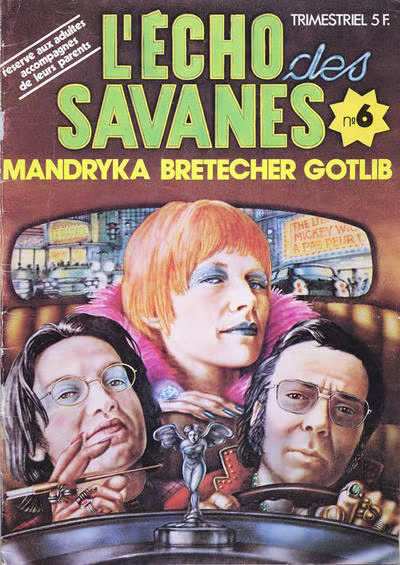
L’ECHO DES SAVANES was a French comics anthology magazine. This issue is from 1974. Those are the three editors and founders on the cover, the cartoonists Nikita Mandryka, Claire Bretecher and Marcel Gotlib. First, let us admire the flex: the editors had themselves painted for the cover of their own comic.
The tone of the thing? These three want to take you on a midnight ride through the dirty city. Gotlib looks a bit sleazy, Mandryka is a sinister intellectual and can we all just agree that Claire Bretecher looks incredibly fucking cool? You know what’s being promised.
Even in an age of fantastical comics covers in France, I bet you no other editorial team were getting themselves painted for a cover as creatures of the night who were ready to take you places you may not be ready to be taken to.
As an object, it is of its time, and there’s a little bit of big-head caricature to it. But it’s a lovely bit of painting, and the whole thing just makes me smile. It bypasses all the rules we have for comics covers and rides off into the dark.
Next time you’re near a comics or book store, have a look at the shelves, see what jumps out at you, and ask yourself why. It’s a useful question. And you’ll learn more about your own tastes as well as what design does to you.
No, I don’t throw much away. And this is a central part of me. This issue, for example, is where I discovered Mariscal. Which lead, decades later, to me dragging my family around the Mariscal installation at the London Design Museum.
I loved ESCAPE and it was a crucial element of my education in the medium. I owe Paul and Peter so much.
Also inside, presented sideways, some prime early Eddie Campbell:
The slow process of reorganising my home office means I’m finding old treasures tucked away safely at the bases of piles. Like this: my signed and dedicated copy of SCARLETT TAKES MANHATTAN by Crabapple and John Leavitt.
A young woman orphaned in tragic circumstances (by a pair of copulating circus elephants) rises to become the foremost burlesque performer of her era: Scarlett O’Herring. Mentored by the mysterious D’Lovely, Scarlett is a fire-breather, courtesan, and the heroine of Dr Sketchy’s Anti-Art School founder Molly Crabapple’s first graphic novel. “Scarlett Takes Manhattan” is a delightful erotic romp through the exotic world of Gilded Age New York!
It’s really a glorious thing. Full colour, clever palette, and she really knew what she was doing with nine-panel grid.
I was clearing a corner of the office when I came across this, which I bought in 2099 (it’s the oversized hardcover). For me, it’s Seth’s most charming work. Originally a serial in the New York Times, it’s the life story of a Canadian television personality told through the memories of those who had connections to him. There’s a Guy Maddin-y sort of lost Canadianness to it, to my eye, as well as the sense of lost media culture and lost ways of living and exploring. A lost sense of wonder.
There is melancholy to it. There’s regret, and the mess of life. But it’s so beautifully done. It may actually be my favourite work of his.
I have to get back into writing in nine-panel-grid later this week. In theory it should be easy – nine-panel-grid is supposed to be essentially invisible, the equivalent of the word “said” in prose. In practise it is exhausting. I’d forgotten how exhausting. Finding up to nine images in every page that are interesting and feasible and won’t bore an artist to death. It uses up the brain. It shouldn’t! But you can’t make an artist fill a book with talking heads and fixed POV, and you can’t fill a panel with so much detail that nobody can see the story. Or so many words that the picture is covered and not able to do its own work.
Jason Howard sent me an advance copy of his new series with Ryan Stegman, THE MISSIONARY, which I believe goes to final order cut-off next week (it’s published by DSTLRY). I have a note on it in Sunday’s newsletter, but for the purposes of logging here, I’m just going to jot down that it’s big dirty fun, very dense, high energy. Jason kills it.
That change came quickly with issue 19, heralding a redesigned logo and more of an inclination towards its older age group. The masthead also now carried the words ‘Anti-Mysteron Edition’, and warnings about the Mysteron threat. As the Captain Scarlet TV series hadn’t even begun yet, this may have led to a few confused readers.
Unsurprisingly, the revamp didn’t help sales and Solo published its last issue dated September 16th 1967, still a week or two before Captain Scarlet began on ITV. Its chilling cover headlining the ‘Victims of the Mysterons’, – presumably photos of staff members at City Magazines.
And more:
Inside, Spectrum News tied in with the cover story, and was equally bleak, whipping up its young readers’ paranoia against an imaginary menace.
People used to wonder why the British comics crew produced such odd stuff.
I don’t know how under the radar this book is. For all I know, everyone talks about it the minute a new issue comes out. But that conversation never pinged my ancient old radar screen. I love this project. Writer/artist Dustin Weaver uses this series, essentially an anthology, to explore older forms of the medium, largely European, and to adapt elements of those forms for the present while revelling in their styles and possibilities. There’s the tools of Giraud and Gillon, Bernet and Crepax on display, all set within Weaver’s own eccentric gaze and hand, and some excellent performance of colour-as-storytelling. PAKLIS is, perhaps, a book for people who love the comics form. It’s a thing to study, for people who want to immerse themselves in marks and progressions and page shapes. Also, it’s a lot of fun and gorgeous to just look at. But it invites you to learn more about the form, and to watch Weaver himself learning about the form, and is invaluable for that. There’s nothing quite like PAKLIS out there.