Skip to content →

Category: work

On Creating THE AUTHORITY With Bryan Hitch

authority clip issue 3

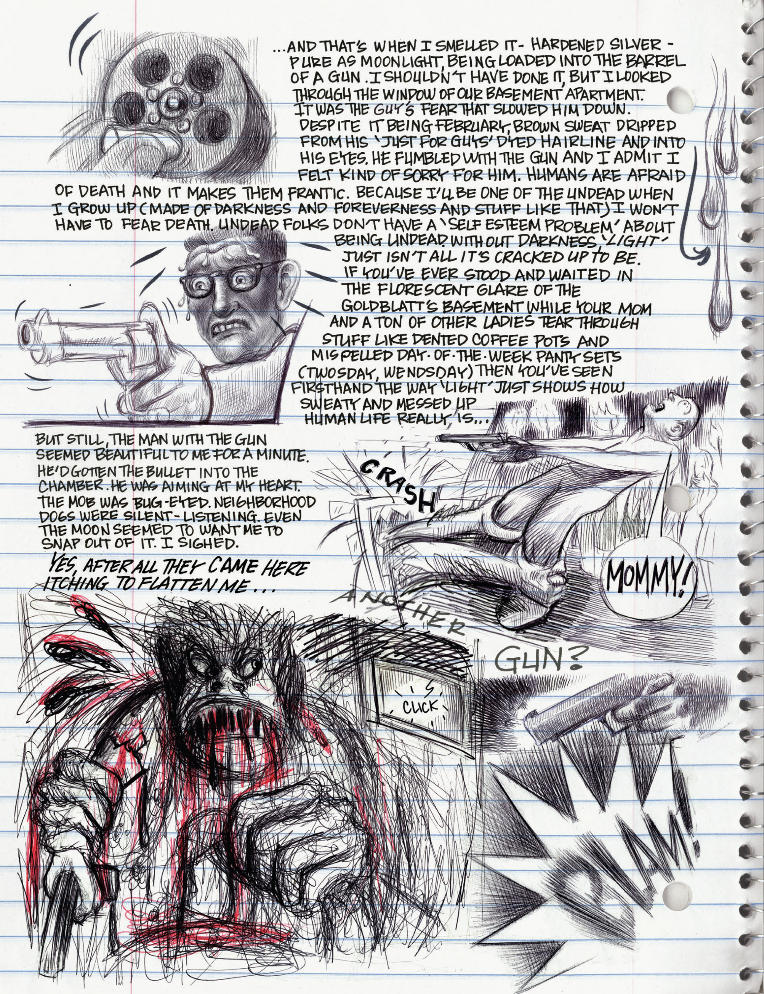
It was very weird to learn that James Gunn is planning a movie based on THE AUTHORITY, the comics series I created with and for Bryan Hitch. (I got phone calls from Jim Lee and everything.) Apparently these characters are going to be all over the first phase of James’ DC Comics film sequence.

Here’s the short version of how and why I did THE AUTHORITY.

I’d been doing a book called STORMWATCH for Wildstorm. We relaunched it once. Bryan Hitch came in and did a few issues of the second run with me, which is where we created Apollo and The Midnighter.

(Apollo, because the sun-god metaphor made connections with Superman. The Midnighter, because Batman was once called “The Darknight Detective” and because my dad, in his youth, was a drummer in a band called The Midnighters.)

Bryan and I gelled really well on those issues. We were talking regularly, and I started wondering what else we might do together and what I could write specifically for him. Around that time, I happened to find out the actual sales figures for STORMWATCH, and called the office in horror. The sales figures were like negative eight hundred. It was an actual comics black hole that reversed the laws of capitalism, the sales were so bad. “Why are you still paying me for scripts?” I asked. “Why are you still publishing them?”

What happened next tells you a lot about what kind of people worked at and ran that company, including Jim Lee and Scott Dunbier. This was twenty-five years ago, but their response was something very much like “We really like it and we always want to find out what happens next, so we’ll keep publishing it until you don’t want to write it any more.”

I was gobsmacked and MORTIFIED. I felt so fucking guilty I just sat there in my chair for hours.

And then I started coming up with a plan to repay them by coming up with a version of the property that actually made them some money. In the next moment, I realised Bryan was going to be the perfect partner for that, so I wrote it very much for him. I already had one of the five best colorists in the world at that time, Laura DePuy. All I had to do was convince her to stick with me a little longer and give her space to push the envelope of what was possible at the time.

And that’s how THE AUTHORITY happened. We did twelve issues, and then I told my editors to hire Mark Millar and Frank Quitely to replace us, which they did. And, with that hiring, actual comics history was made, and I repaid my debt to my wonderful publisher. (Aside from the debt of gratitude I will always owe to Scott and Jim and everyone else there.)

THE AUTHORITY by Warren Ellis, Bryan Hitch, Paul Neary and Laura DePuy Martin is back in stores.

(A version of this previously appeared on my free weekly newsletter)

One Comment

CARNAGE: Web Of Carnage

This just arrived today, so I guess it’s on release imminently: in this “Epic Collection” of old Carnage stories – you may have seen Carnage, the “red one,” in the film VENOM: LET THERE BE CARNAGE — is contained one of my earliest graphic novellas from close to the very start of my career in American comics, CARNAGE: MINDBOMB with the excellent Kyle Hotz illustrating. (I just looked it up – 1996!)

And Kyle gets the back cover:

Looks like it’s available to order now.

Comments closed

Finals Week

Had a lengthy call with Mr. Callis the other day – which sidetracked into electronic music history quite a bit – which set me up for doing the final polishes on DEPARTMENT OF MIDNIGHT, which then go into the system to prep for recording next month. So I need these locked by Friday. Some writers love polishes. All I ever see are the things I somehow managed to not fix in the previous drafts, and I spend hours cursing Past Me for being bad and stupid.

Comments closed

The Call Of Audio Drama

Julian Simpson’s excellent rumination on writing action in an audio drama also has this bit in it:

If we’re going to make this medium work, if we’re going to compete on the world stage, then we need to embrace audio for all it can do. This isn’t cheap movies, or talking books, it’s its own thing. The Americans are starting to throw money at it but they want to spend that money on movie star voices, which doesn’t actually aid the form at all (some brilliant movie actors lose all their power when you only hear their voice), and movie stars don’t want to spend a week on location for no money, so the shows are recorded over a morning in a studio and the quality suffers as a result.

We are capable of making extraordinary pieces of audio in the UK; we have great voice actors, brilliant technicians, and producers who understand the medium. What we need now are ambitious, imaginative storytellers, and an industry that doesn’t turn its back on the medium just as it is approaching its heyday.

This is where I have to say that I am doing THE DEPARTMENT OF MIDNIGHT with American partners, two British actors and five American actors, and the post will all be done in the States. Because I always wanted to try audio drama but (like the vast majority of my work) nobody in Britain was ever interested. And, yes, some movie stars may lose their power when you only hear their voice – I can guess which well-known audio drama podcast he’s referring to – but DEPARTMENT OF MIDNIGHT also has movie stars as well as tv stars, actors who count their voice as one of their instruments, and the limitations of studio work actually open up different avenues for performance and atmosphere.

The audio drama serial we’re doing after that will be set in the UK and use British actors. With American partners and post, because, see above, and see what Julian’s saying. And his notes on writing audio drama are invaluable and I wish I’d had them last year….!

Comments closed

THE DEPARTMENT OF MIDNIGHT

We are pleased to announce the audio drama podcast serial THE DEPARTMENT OF MIDNIGHT.

THE DEPARTMENT OF MIDNIGHT stars James Callis (Battlestar Galactica, Castlevania, Picard), is created and written by Warren Ellis and is produced by Kevin Kolde, Fred Seibert, Brian Guicciardo and Warren Ellis with casting and voice direction by Meredith Layne.

In THE DEPARTMENT OF MIDNIGHT, haunted scientist Dr. John Carnack is employed as a crash site investigator by the Department Of Experimental Oversight: colloquially known, after the Doomsday Clock that ticks down to 12, as The Department Of Midnight. When a breakthrough, esoteric scientific experiment goes wrong, he’s there to find out why, and to save who he can. THE DEPARTMENT OF MIDNIGHT presents six stories of mad science and otherworldly horror.

THE DEPARTMENT OF MIDNIGHT will be released this spring. Further details to follow.

Comments closed

How Do You Choose The Medium For Your Story?

A thing I’ve been asked often in the past: how can I tell when a new idea is a graphic novel or a prose novel? I’ve previously answered that it’s instinct from experience, but that’s not very helpful. And the question occurs to me again this week because in the past few days I’ve started work on a new idea that I instinctively knew was a comics series. I usually don’t develop comics ideas without a specific artist in mind: I develop for and with them, to their skills and interests. TREES, for example, comes as much from Jason Howard’s curated moodboards and curiosity collections as it does from my own obsessions.

To begin with, I will say: this is my personal approach, not an immutable physical law. Find your own way of doing things, make your own rules.

The two things I consider first are information and interiority. The comics page radiates less information than the prose page. And serious interiority tends to require lots of words, and the comics page can only usefully interpolate a certain volume of words.

(Various people have expressed various different “rules” for that. Stan Lee claimed something around 28 words of text in a panel, as I recall. Mort Weisinger said it was 35. Alan Moore once suggested it was 210 words per page. See how those work for you. Lettering was a lot bigger in those days, but lettering is a graphic actor in the panel. And then look at the brilliant Emil Ferris in MY FAVORITE THING IS MONSTERS breaking every “rule”)

ferris.PNG

The third – how boring is is going to be for the artist to draw?

These things can connect in different ways. There are artists who love nothing more than drawing acting, physical language, facial expressions. This is one of the reasons why I prefer to develop comics with an artist in mind. If your artist is absolutely allergic to “talking heads” comics, then your calculation will shift.

What does your artist want to say? (This is the rule I’m breaking right now with this story idea. Maybe I’ll find an artist who finds what they want to say in it, or just fancies drawing it. Maybe I won’t. It happens.)

Comics and books have different toolkits. One is not “better” than the other. Each is capable of effects that the other is not. There are things I can do in comics that would be near-impossible to even attempt in books, and they wouldn’t have the same effect anyway. (Also, be aware at all times that a comics script is only ever half a piece of art — it’s not a complete statement until your collaborators have finished.) Prose has access to a bunch of tools that comes can’t always get near. Comics and prose even have different ways of approaching time itself.

What does the idea require in the way of length? You need a very long graphic novel to tell as much story as in a mid-length prose book. Most things we think of as graphic novels would come in as novella length if they’d been done as prose. This can be the killer. If I know I’m going to need sixty thousand words to elaborate the idea, the decision’s been made for me.

But also: how does the imagery of the idea strike me? How specific is it, in my head? Describing an image down to its finest edges in prose can freeze it and kill it — you have to suggest it, so it takes on its own life in the reader’s head. If you need to see it on the page in all its clarity for the thing to work for you, then it’s a visually-led story.

I only had a handful of very strong images for GUN MACHINE, but they were simple enough that they’d have more life in prose. And almost everything else happening in that book was happening inside John Tallow’s head. In NORMAL, the visuals had strong and complex motions to them, and, aside from that book being very interior indeed, they would have been a pig to draw.

TREES needed the Trees. It wasn’t going to work unless you could see them, feel their massive presence in the landscapes, the sheer alien pressure of them on the seen world. It wasn’t enough, for the story, to just tell you they’re there. Their silent weight had to be present.

(Which is a weird thing to say because Jason Howard’s art is generally all about motion, as anyone can tell. But Jason can do anything, basically.)

What does the story need to be its best self? That’s the thing you learn by trying.

RELATED: Comics And Time, a short talk I gave some years ago in Dundee.

(Written 3 April 2022)

Comments closed

Cutting Wood For A Chariot: On Trying To Build A New Project

I sawed down some huge holly boughs the other week, and they needed to be cut into plant stakes. Holly is, of course, just horrible to handle, and the leaves prick even through good gardening gloves. But, with care, you can strip the branches and leaves off. Holly is a very hard wood that tends to grow fairly straight – it used to be used for chariot axles, and is in demand today as material for walking sticks. Veteran walkers are known to cut themselves a holly stick at the start of their rambles, as noted in Robert Macfarlane’s THE OLD WAYS. (UK) (US/CAN/EUR+)

I live in what was probably the outer edge of Catuvellauni territory, and it’s an interesting thing to grasp a holly trunk and imagine it being cut into an axle for a chariot being ridden against the Romans. Caratacus of the Catuvellauni fought a resistance against the Romans, and the story goes that when the Brigantes betrayed him and handed him over, the Romans took him back to Rome as a prize and made him allocute in the Senate. His speech was so impressive that he was immediately pardoned and he and his family were invited to live in Rome. His last recorded comment is something along the lines of, “you live in the greatest city in the world, what the fuck did you want with our shitty huts?”

That was our holly that Caratacus flew across Essex on.

I needed the stakes to pin back some over-energetic bedding plants. Once the season is over, I can cut back the plants and remove the stakes, which I can then saw into smaller pieces for firewood. Holly will burn very well when “green,” but I’ll probably bundle and hang the pieces for a few months as a brief seasoning before they go in the fireplace for Christmas house heating.

And, the whole time I’m doing this, I’m working. Listening to podcasts while I’m doing the physical stuff, thinking about stories in the rest periods. I’m currently working on a project that I’ve been told to think about it as a “label.” It only has one piece so far, and we’re aiming for three. I’m doing construction in my head.

Being told you have a label is the sort of thing you dream about as a younger writer. You enter the field bursting with all the ideas you’ve been thinking about for years. Usually regardless of whether or not they’re any good.

They’re yours, and you’ve been dreaming about being able to tell them for so long, and all you want is the chance to get them out of your system. The test of you as a writer is whether or not you have more ideas once your original box of dreams is empty. Sometimes you’ll plant up the new shoots of ideas before they’re ready, just because you need to prove you can come up with new stuff. God knows I’ve published enough not-ready-for-sunlight stories with rotten roots. Once you see that you’ve done that, you know, A LOT, you get pickier. You distrust your first thought. And your second, and sometimes your third.

Aaaaand then you reach the age of 103 and some people show up and place their trust and resources in you and say, “this should be like your label,” and you immediately distrust all your first thoughts about what that could contain. You can’t fuck around with that. You have to show up as your best self, at full power, to justify that trust. You’re very aware that there’s a gulf between the ideas you might, in an idle moment, want to give some oxygen to, and the stories worth telling.

So, yeah. I may be digging holes and building things and shredding my skin as I whittle myself some holly stakes, but I’m working. I’m thinking about what’s next, and what stories are worth telling. And trying not to get potting soil inside the notebook pages. I need some solid axles for the chariot I’ve been asked to make.

(Adapted from a segment in my weekly newsletter: you can subscribe and read a few issues at this link.)

Comments closed

The Only Good Notebook

The only good notebook is the one you’re carrying.  It’s no use to you if it’s still sitting at home because you don’t want to bend it or it’s too difficult to carry or you can think of any other excuse to not have it with you at all time.  The only good notebook is the one you can afford.  I wrote the first draft of an entire short book in a reporter-style notebook I bought in the local post office for 50p, and that was only a few years ago.  Stephen King doesn’t write ideas down because he believes that if he doesn’t remember the idea later, then it wasn’t interesting enough to be in a book.  You are not Stephen King.

I, and other writers I know, fetishise notebooks because we work in them a lot and we eventually get picky about them and have disposable income for that sort of thing.  We don’t get out much.  But I started out writing in the cheapest notebooks I could find.  My earliest professional comics work was all roughed out in crappy notebooks on the back table of a late-night burger bar with a Biro, scribbling away at three in the morning while drunks and ravers with nerve damage staggered in and out of the place.

It doesn’t have to be an expensive or fancy notebook.  It just has to be the one that doesn’t leave your side.  Write it down.

Comments closed

Five Hundred Words

No, really. Graham Greene only wrote five hundred words a day. Which sounds like nothing, until you take the long view:

“Over twenty years I have probably averaged five hundred words a day for five days a week. I can produce a novel in a year, and that allows time for revision and the correction of the typescript. I have always been very methodical, and when my quota of work is done I break off, even in the middle of a scene.”

And that produced 25 novels, two books of poetry, four autobiographies, four travel books, eight plays, 11 screenplays, four children’s books and a shitload of short stories. All off 500 words a day.

(taken from an edition of my newsletter, ORBITAL OPERATIONS, which can be subscribed to here)

Comments closed

What I’m Talking About When I Say I’m Thinking About New Stories

The following was written for the 17 April 2022 edition of my free weekly newsletter, which you can subscribe to here.

This coming week is for new ideas. Now, I can’t force new ideas, but I have processes for helping them emerge. Let me try and explain by an extended example which will show you exactly how terrible my mind is. Like:

So the last thing my collaborator threw up in conversation was ALPHAVILLE, the Jean-Luc Godard film, shot in black and white and using diegetic found light rather than the usual artificial lighting rigs. That light is nonetheless often quite high-contrast, which brought to mind the first, best and most interesting SIN CITY book, which also connects to ALPHAVILLE through its hard-boiled noir underpinning, and if you read it backwards Miller goes from the artist of the later SIN CITY books to the artist of ELEKTRA LIVES AGAIN, with dizzying one-point perspectives looking down through buildings, which made me think of Coen’s THE TRAGEDY OF MACBETH and its abstracted environments:

TragedyOfMacbeth_Film_F5016.jpg

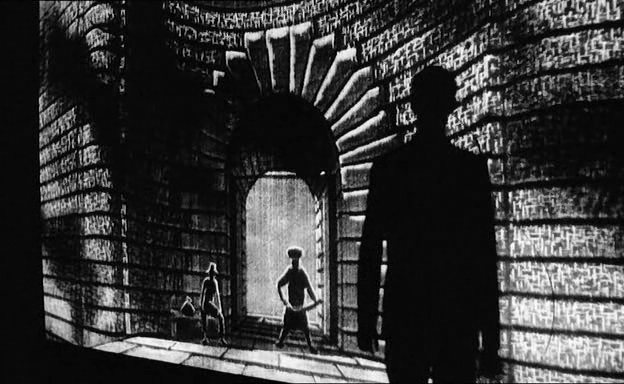
Which leads me off in a few different directions, like Orson Welles’ THE TRIAL, shot in the then deserted Gare D’Orsay:

005cg.png


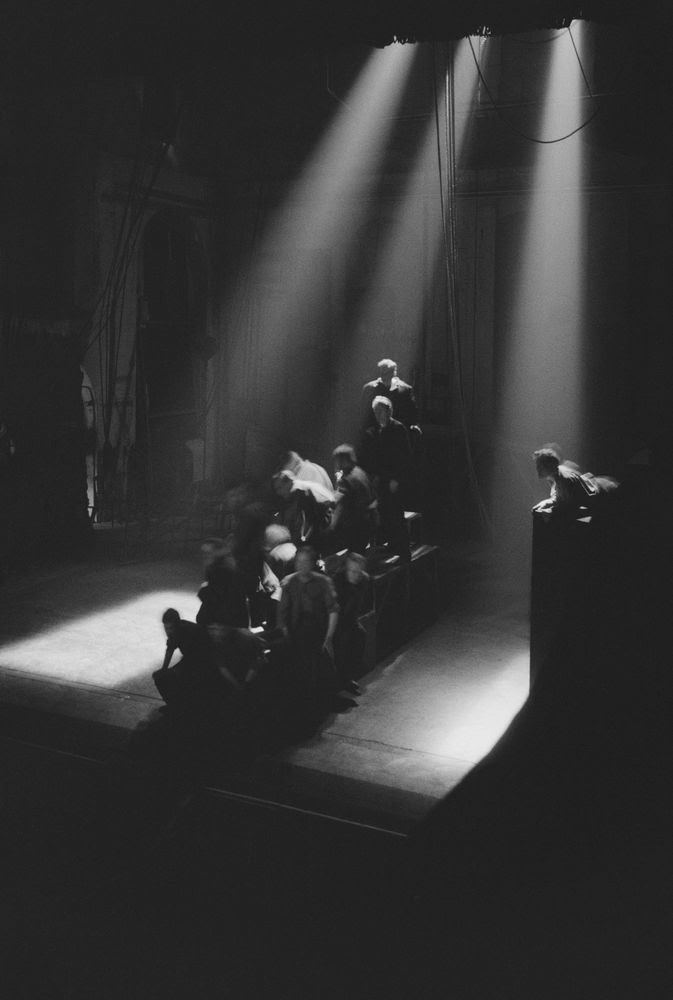
And the surviving images of Orson Welles’ black-box-theatre production of MOBY DICK (see how it pops up everywhere?):

MA_I551443_TePapa_Orson-Welles-in-Moby_preview.jpg

In which Welles worked with Patrick McGoohan, whom Welles described as “intimidating,” and McGoohan once put on his own black-box production, which was the penultimate and best episode of THE PRISONER, essentially a two-hander between him and the magnificent Leo McKern (with Angelo Muscat as essential colour), who, tv myth would have it, nearly died of stress from shooting the episode. Wikipedia, in fact, says this:

According to the 2007 Don’t Knock Yourself Out documentary, during production and filming of the episode both McGoohan and McKern became totally engrossed in their roles and almost achieved a near-psychotic state (cited by various people, including Leo McKern).

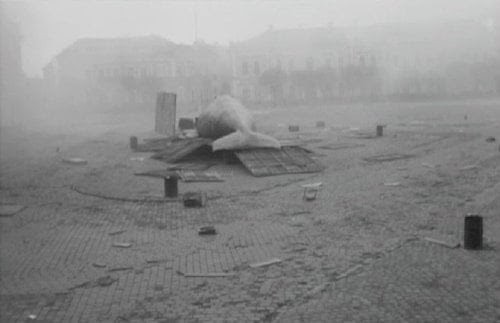
It is full of very artificial lighting tricks, anxiety and paranoia. The latter two descriptors describe Kafka very well, and Tarr’s WERCKMEISTER HARMONIES to some extent, also a black and white film, also misty like Coen’s MACBETH:

werckmeisterharmoniespic.jpg

There’s an abstracted environment for you.

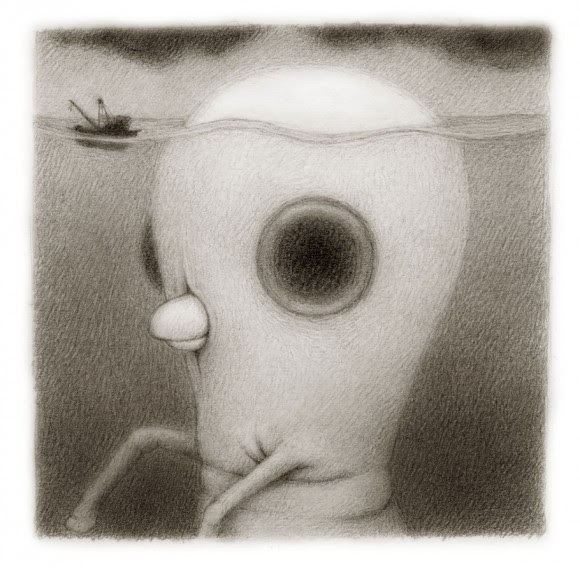
(And suddenly I’m thinking about the actual genius that is Renee French:)

bjornstrandbacks-580x568.jpg

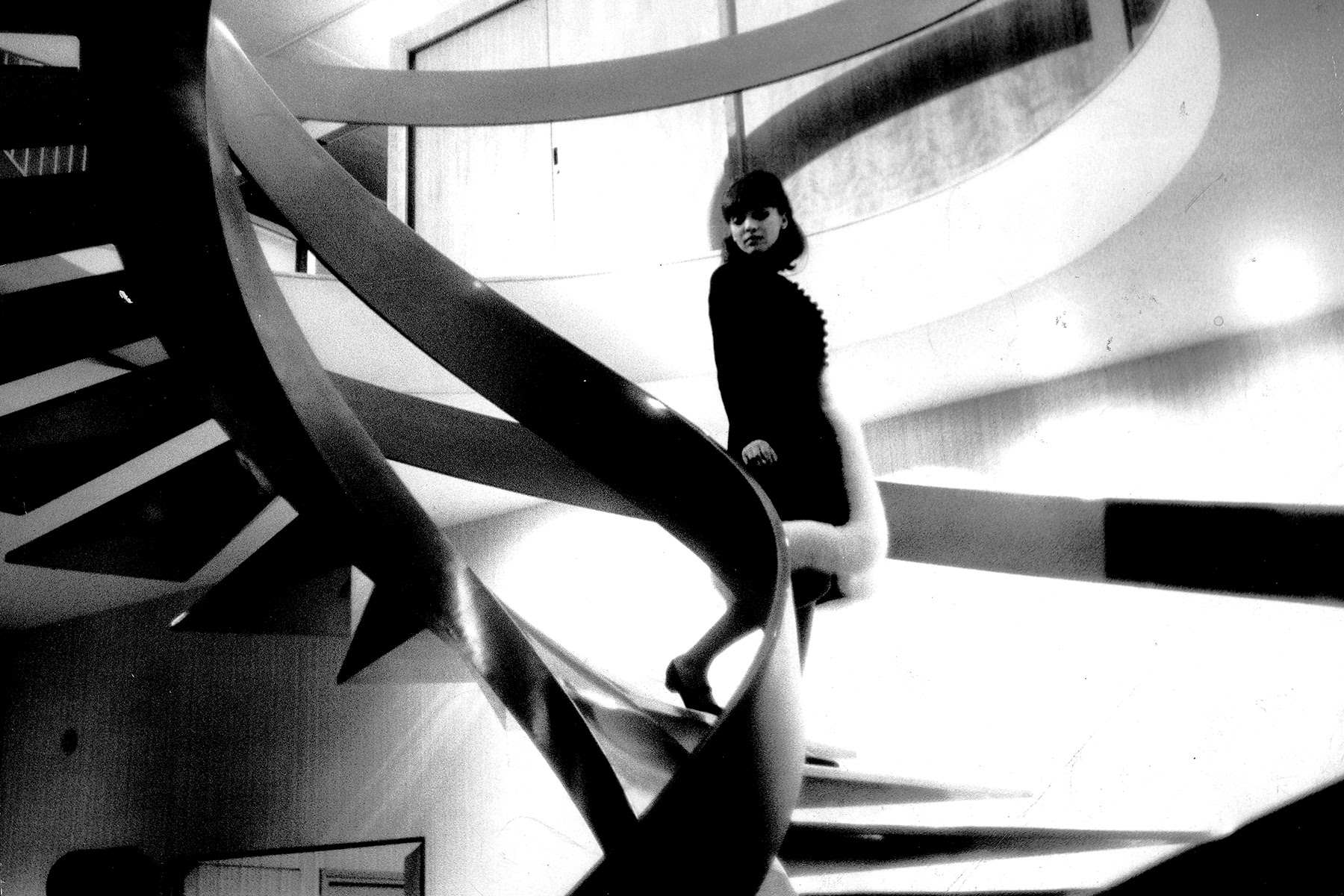
Tarr started as a documentary maker, working with available light and handheld characters – just like Godard in ALPHAVILLE. Circle back to ALPHAVILLE for a second:

GAC_Alphaville2.jpg


The contrasts, the structures and the moods they project, the strangenesses made from otherwise ordinary places and things. Even black boxes and found props. Limited settings. Limited light. ALPHAVILLE is about messing with minds. So, of course, is Macbeth – if the three fates hadn’t put the idea in his head, would he have killed Duncan? Or did he get incepted? (Unpopular opinion: TENET is Nolan’s best film, a better mind game, and it uses architecture better. It stars the son of the actor who plays Macbeth in Coen’s film.) Mind-game stories: WERCKMEISTER, and THE PRISONER, and THE TRIAL, and the whole trick of Welles’ MOBY DICK (technically, MOBY DICK – REHEARSED) is that you’re told you’re watching actors rehearse a performance of MOBY DICK but the secret of black-box theatre is that you are immersed in it until you’re tricked into seeing boxes and assemblages of people as the boat in the ocean.

What is real and what isn’t? That’s the central concern of Philip K Dick’s fiction, talking of anxiety and paranoia. (Dick’s Cold War dark half, Steve Ditko, and his 50s b/w horror comics, all sweaty fear and distrust!)

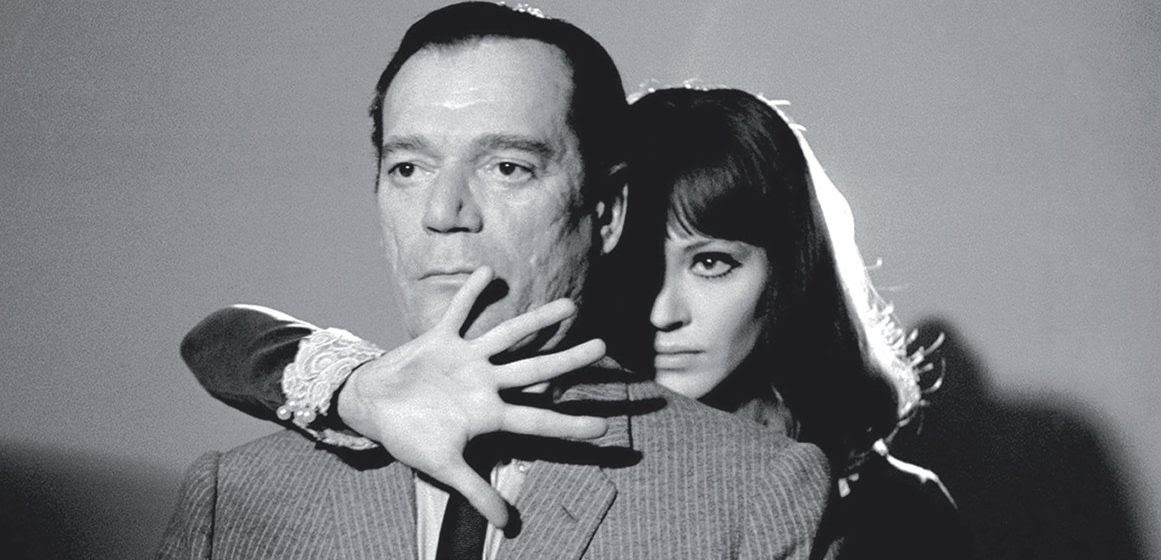
And this still from ALPHAVILLE always puts me in mind of Cocteau’s ORPHEE for some reason and I’m not going down that rabbit hole right now but I’m glad I own it on disc:

LEMMY-CONTRA-ALPHAVILLE-1161x560.jpg

And yes, I’m free-associating through previous works of art, but I’m also thinking about the powerful effects these works had on me as I first experienced them and then as I learned more about them, and consideration of these things leads me to examine the tools they used to achieve those effects, while at the same time I’m thinking of moments in my life where I was caused to believe things that were not true, or when I could not decide when something was real or not (in the context of the thing and the moment and my brain chemistry) — and, somewhere in the middle of all that, I have a space in which to garden a story idea or two. It’s a story that grows in anxiety and paranoia, in estranged and abstracted environments, in shadows and mist. I can see the place it lives in, how it moves, and feel its weather.

When I talk about taking in as much information as you can, and then store it and let it compost in the back of your brain and make its own connections? This is part of what I’m talking about.

Comments closed